Sunday, January 9, 2011

Because I Enjoy Making Bulleted Lists...

I'M HOME... after 26 hours of travel, oy.  Someone really needs to work on that whole teleportation thing, because that trip was just plain brutal.
I know its been a while since I've arrived home, and longer still since I've posted last, but let's just blame it on jet lag and my needing an extended adjustment period, alright?  Good, okay, glad we all agree.

America is too cold and there are too many mzungus here for me to handle.  Reverse cuture shock is NOT a fun time.

Instead of venturing out into the white (in multiple respects) freezing tundra, I'm writing bulleted lists and missing Africa.

Things I've come to love and miss about Africa:

  • Bridget, my homestay sister, and her feral child, run like the wind, giri giri-loving ways.
  • All forms of African public transportation... well, mostly just boda bodas.
  • My Gulu family: John Bosco, Rose, Bridget, Marina, Michelle, Paul, Teddy, and Kulusum.
  • Mujaja tea.  SOMEONE FIND ME THE EQUIVALENT IN ENGLISH.
  • The Gulu market and all of its wooden-stall glory.
  • Being able to cook dinner for twenty for under $75 dollars.
  • Accents and the fact that I developed one.
  • Trying to teach Spanish to people whose language does not have the "r" sound.
  • Power outages.
  • Water outages.
  • Rolexes and our rolex sebo.
  • The Mzoo.
  • Being able to walk everywhere.
  • Children asking for papaya outside our gate.
  • Quiz Nights with the gang.
  • Making new friends wherever I go.
  • Constantly encountering people who just want to say hi, ask how you are, and go on their merry way... for no reason other than, well, there's no reason not to.
  • Driving through the bush in a rusty matatu, queuing a playlist that tugs at my heartstrings, and using the closest any of us could get to alone time to get up in my head and think about life.
  • Boy Meets World and How I Met Your Mother marathons with Luke.
  • Hookah Thursdays at Shokola in Kigali with Luke and Rachel.
  • The night sky in Gulu.
  • Mango juice.
  • Nighttime thunderstorms.
    • To expand on this, one of my favorite things:
      almost every night at my homestay in Gulu, I would sit on the porch at night and watch the rainy season's storms roll in.  My family thought this was very strange behavior, but it was one of my favorite things to do.  You could see the lightning blaze through the black sky, feel the wind on your face, and sense that the temperature of the air was dropping.  The clouds would gather, the stars would disappear, and next thing you knew, the rain was falling.  Never did it begin with a drizzle and build to a storm, oh no.  It would start and end as a terrific downpour, drenching anyone caught without shelter and blowing our heavy windows and doors shut.  Soon after it had passed, you could see the million stars again, as if nothing had happened at all.
      We all need to take more time to be in awe of Mother Nature.  She can be terrible, but that terror can also be beautiful.
  • Being introduced as her firstborn by Rose, my homestay mom.
  • Being awoken by the sun, not an alarm clock.
  • The sky, both day and night.  If you haven't seen it, you'll never understand.
  • Constantly being surrounded by natural beauty.
  • Using my headlamp.
  • Being surrounded, 24/7, by people who are as passionate as I am about the things I'm passionate about.  That's been a new experience for me, and I cherish every single one of them because of it.  We needed each other to get through this experience, and it made us a family.
  • The music that's always playing wherever we go.
  • Life-affirming talks with Rachel.
  • The Kimironko family... "Don't be intimidated when you see me at the taxi park this morning, I have my shirt tucked in."
  • The Nile group.
  • Bartering in the market.  I tried to in a thrift store last weekend... what a fail.
  • Wearing clothes that have been dried by the hot sun.
  • Drinking tea every hour of the day and night.
  • Kivu Shore: live it up, drink it down.
  • All forms of produce.
  • Digging a fire pit to finish cooking a meal when the stove breaks.  (AKA the most successful group effort ever).
  • Feeling so alive, for the first time in my life.
  • Language ticks and how habit-forming they are.
  • Being outside under the sun all the time.

Things I do not love and do not miss:
  • Cockroaches.
  • Rats.
  • Sleeping on the floor.
  • Mosquito nets.
  • Matooke.
  • Posho.
  • Dust.
  • Never feeling clean.
  • Washing clothes by hand.
  • Near-death experiences in Kampala traffic.
  • The smell of burning trash.

Language ticks I brought home with me:
  • "My dear."
  • "Even me, I don't know."
  • "Sorry sorry."
  • "Mmm." - as a response to anything you would normally respond to with a "yes."
  • "We go."
  • "You come."
  • "Ah!" and "Eh!"
  • "The what?"
  • "Even me."
  • "For sure?"
  • "You want what?" and "You are going where?" ...essentially all inverted sentence structure.
  • "You will take what?"
  • "S'okay."
  • "Faster faster" and "slowly slowly."
  • In the same vein... "small small" and "big big."
  • "You, you are very stubborn."
  • "This one, he's very rude."
  • "You are so smart!"
    ...And essentially the accent in general.  Even me, I love the accent.

A few lessons learned:
  • In America, we have so much more than we could ever need.  As a collective people, we don't stop to recognize or appreciate that fact as often as we should.
  • Reconciliation and healing are not just nice ideas to hope for, they are tangible and achievable.
  • The people that I encountered, many of whom have experienced the worst tragedy and human cruelty anyone can imagine, are some of the sweetest, kindest, and most giving people I've ever met.  Despite hardship, despite pain, they are able to move on and appreciate their lives and count their blessings.  I think its an attitude everyone could learn from.
  •  Time isn't always as important as our society deems it to be.  Its much better for your relationships, and your soul, really, to live in the moment and not worry about the next errand you have to run or place you have to be.  Slow down.  Don't rush.  Appreciate the person in front of you instead of running off to your dentist appointment.  You'll get there eventually.
    In Africa, we keep appointments, not time.
  • Africa is nothing that you anticipate it to be, in every possible respect.

Little things I have a new appreciation for about America:
  • Seeing family & friends.
  • Hot showers.
  • My bed.
  • My dog.
  • Driving my car... on the right side of the road.
  • Free (and reliable) internet.
  • An expanded wardrobe.
  • Refrigeration.
  • Real coffee.
  • Unlimited texting.

As much as I love bulleted lists, I think that's enough for now.  I have a lot more to post as far as reflections after returning home, as well as a lot of commentary about the chaotic times East Africa will soon be facing (the Sudanese referendum this week and elections in Uganda in February), so if you're so inclined, keep checking back.

If you know me, you know I usually have a lot to say, and when it comes to Africa... you ain't seen nothing yet.

Do not ask what the world needs.  Ask what makes you come alive, and do that.  Because what the world needs is people who have come alive.

ISP, Visiting the Village, and LEAVING UGANDA. OY.

Because I haven't written since leaving Gulu two weeks before my departure, I have a lot to catch up on with this blog.  Here we go.


ISP:
In other words, Independent Study Project.  For those of you unaware, a large component of SIT's program is the independent study.  It counts for a majority of the grading and actually will count for an entire class in and of itself on my Lafayette transcript.


For the last month we were in East Africa, we were split between Gulu and Kigali, living on our own doing independent research.  I lived with ten of my classmates, in an orange house we nicknamed "The Mzoo" that had no furniture besides our mattresses.  Suffice to say, it was a fun month.
the Mzoo.
My topic was NGOs in IDP camps in Northern Uganda (too many acronyms?  non-governmental organizations, basically foreign and domestic aid groups, in internally displaced persons camps).  Because of the war in Northern Uganda, over 2 million people were moved into camps beginning in 1996.  In the last two years, many of these displaced people have returned home, but not all.  There are many still remaining in the camps, either because they have encountered land disputes or because they are EVIs, or "extremely vulnerable individuals" - the elderly, the disabled, and orphans/child-headed families.
an example of life in an IDP camp.
When people began leaving the camps two years ago... so did the aid organizations.  My goal was to look at the effectiveness of the organizations still operating, and how relationships between the community and the NGOs could be improved.
My ISP was ultimately titled "Community Consultation and Communication as a Key to Effective Aid Provision: A Case Study of Lukodi IDP Camp."  Let's just say if there's one thing I'm good at, its alliteration.

To sum up a 47-page paper in four paragraphs or less:
For one month I immersed myself in Lukodi IDP camp, about a 40 minute boda ride/one hour car ride from Gulu.  There are only about ten households that still call Lukodi home, and the people I met with there had a lot to say.  There were many NGOs to discuss, among them ChildVoice International, Christian Child Fund (yes, the ones you see the commercials for on TV all the time), Caritas, and formerly the World Food Programme and the Norwegian Refugee Council.
Caritas Gulu compound: one of the foci of my research,
as well as the office my host father ran as Director.
The major complaint was that these groups did not consult with the community before initiating programs.  They had little understanding of how these groups operated, how their budgets were being spent, or why they chose to implement the programs they did.  There was even less appreciation for the services being provided.
I then began interviewing NGO workers.  I met with representatives from both Caritas and ChildVoice International, all of whom stated that although there was little int he way of community consultation, the community was also partially at fault.  Due to their lack of understanding that NGOs are limited in their resources and their focus (for example, the mission of CVI is child mothers, but he community complained about them focusing only on child mothers), the community was uncooperative.
These are all problems that are able to be remedied.  With clearer communication between the aid providers and aid receivers, better relationships can be forged.  And once better relationships are forged, aid can be provided more effectively and thoroughly.

There, now you don't have to read 47 pages of field notes, methodology, and findings.  Concise, not so?


The Village
After ISP was finished, we had a little less than a week left in Uganda.  Because we were evacuated from Gulu so early (update, the mystery illness is yellow fever), our group trip to Murchison Falls was canceled, which left us in Kampala with nothing to do.  I skipped out on the last-minute group trip to the east and made plans of my own; some of my family came to Kampala and took me to the village.  Oh boy.
After about five hours on a bus, we arrived in Kinoni in Masaka District, southwest of Kampala.  I can;t really describe what the "town" was even like.  Small.  Dirty.  Small.  And did I mention SMALL?!
We visited family, went to a funeral, and I received marriage proposals left and right.  After almost four months in Africa, I was mostly used to the attention my skin color earned me... but this was on a whole other level.  This was "you're the first white person I've seen in my life" attention.  How intriguing.
The highlight of this story is one simple fact: I slaughtered a chicken.  Almost all by myself.  I had no less than thirty people watching me prove I was a "strong African woman," and halfway through slitting its neck I had a minor panic attack.  Despite my small showing of weakness, I earned the respect of the assembled villagers, and that's all that really counts.


Leaving Uganda, AKA the Biggest Heartbreak of my Life
I don't mean to get dramatic and weepy, but leaving Uganda really was one of the most emotionally difficult moments of my life.  Its rare that a person finds a place with which they connect as deeply as I connected with Gulu.  I have a family on the other side of the world that I know will always take me in, and a place where I feel comfortable and at home.  It didn't help that I have no definite return date and problematic communication with people I've come to love and call my family.
All I want to do is be able to give back to this community that has given me so much over the last four months, and that is what I intend to do in the future.  There is nothing I want more than to return to Gulu.  How I'm going to do that, I still don't know, but I'll figure it out.
Being home is good so far, but I still think about and miss Africa every day.  Its hard to really say what I miss the most: my family, my friends (both Ugandan and mzungu), and simply the atmosphere of Gulutown.  It was the best four months of my life, and a transformative experience.  I'm finding it near impossible to fully describe this amazing journey to anyone who has not experienced the magical spirit of Africa.  I don't know if I'll ever figure out how to do it.  I guess you'll all just have to experience it for yourself someday.


If there's one thing I do know, its that I'll be back faster faster, and I won't truly feel whole again until I've returned.


"I still believe in paradise, but now at least I know its not some place you can look for, because its not where you go.  Its how you feel for a moment in your life when you're a part of something, and if you find that moment... it lasts forever."

Saturday, December 4, 2010

The Leaving Gulu Blues

My eyeballs are trying to eject themselves from my face due to all the crying that's occured in the past 24 hours.

Thanks, ebola/pneumonic plague/mystery illness for unexpectedly moving up my Gulu departure date by a week and a half.

That's right, family and friends, we've been evacuated to Kampala.

I wasn't ready, in any way, shape, or form, to leave Gulu.  I got the call as I walked into the gate of my homestay last night that we were leaving in 12 hours.  Immediately... waterworks.  I thought I had another week and a half to say goodbye, do everything I wanted to do, and prepare myself for what promises to be the most spectacularly emotional goodbye scene on the planet when I leave Uganda entirely in two weeks.  Hollywood, learn a lesson from my life.

I don't mean to be corny (or break your heart, Mom) but I've definitely found a home in Gulu.  I suppose sometimes when you leave home, its possible to find another on the other side of the world... at least for me it is.  And I'll be returning as fast as humanly possible (summer break 2011?  yes please).


Maybe now I'll actually finish my ISP.  I definitely will, considering I have no intentions of leaving my hotel room unless an incredibly enticing offer comes along.

The moral of the story is... I hate Kampala and I hate ebola... but more on that later.


P.S.  Lesson of the Day:  In third world countires (or anywhere, really... let's not stereotype here, people), sometimes friendly neighborhood folk are tempted to steal expensive things.  Namely, my computer.  Good thing I had bigger things to worry about yesterday than a material thing that can be replaced, eh?  Otherwise... I'd be throwing a fit right now.  I'll be mad in a day or two when the leaving Gulu blues have passed and all I want to do is watch a movie.

Wednesday, December 1, 2010

Ebola?! Its Casual

Not to worry, everyone.  I'm not suffering from internal bleeding.  Nor am I rejecting my internal organs through my orifices... yet.

There's been an outbreak of an as-yet unidentified disease in Northern Uganda.  It is suspected to be either dysentery or perhaps ebola (one of mankind's deadliest diseases), and 13 have already died in Kitgum district, about 100 km from Gulu.  One mystery case was brought to Gulu's Laco Hospital last night.  The CDC hasn't reported back yet and neither have the governments of Uganda or the U.S.

The following is the Warden's Message from the U.S. Embassy in Kampala:

U.S. Embassy Kampala, Uganda
Warden Message - November 30, 2010

Outbreak of Unidentified Illness in Northern Uganda

Ugandan press are reporting an outbreak of an unknown severe illness in three districts of Northern Uganda, characterized by fever, vomiting and diarrhea.  The districts identified as being affected are: Abim (specifically Morulem sub-county), Agago (Omiya P’Chua, Adilang and Paimoi sub-counties) and Kitgum (Orum, Namokora and Kitgum Town Council).

While we are seeking to confirm these details, the U.S. Mission in Kampala and the Centers for Disease Control and Prevention (CDC) office in Uganda recommend U.S. citizens residing and traveling in Uganda minimize their travel to these affected areas until further information becomes available.  Non-essential U.S. Government official travel to the three affected areas is presently restricted.


Cheery, right?  Really inspires a lot of confidence.  I swear to God, if I'm quarantined when I set foot on American soil... I might just throw a hissy fit.

We only have about ten days left in Gulu, so if this outbreak hits here (pray to God it doesn't) chances are we'll already be long gone.  Our program director hasn't made any final decisions yet, but there is talk that we may be heading back to Kampala much earlier than expected.

I'll keep everyone updated as decisions are made, but I'm pretty confident we'll be just fine and will finish out our time here as planned.  Knock on wood.


So now, since that was seiously lacking sunshine and rainbows, let's lighten the mood a little bit.

MY FRIENDS ARE THE STARS OF A TOP TWENTY UGANDAN MUSIC VIDEO.
Every day is crazier than the last in this place.  Cross that off the bucket list, ladies.
http://www.youtube.com/watch?v=bdLljCXV-pk

Monday, November 29, 2010

Thanksgiving: African Remix

Being so far from home on an American holiday so focused on family made us all a little sad and incredibly dedicated to doing family dinner for Thanksgiving.  Even though about half the group was content with settling for dinner at an Indian restaurant together, a few of us persevered and convinced the rest that we had to attempt to make a thanksgiving meal.  Although it was complicated (read: charcoal stoves and a serious lack of ingredients... and utensils) it ended up being what I think was my best Thanksgiving yet.

And by the way, I have to say I feel like a pilgrim.  We did Thanksgiving the right way: on a new continent, we improvised with what we could find and we cooked with the help of locals.  This was a REAL Thanksgiving.


 Our substitute for a Thanksgiving turkey.
Yes, we slaughtered two chickens.

 A small sampling of our ingredients.  You would be amazed at what we pulled off with our improvisational market trip.  It may not have been a traditional Thanksgiving feast... but it was goddamn delicious.
The menu:
chicken
vegetable soup
mashed potatoes
pasta and tomato sauce
cabbage salad
curry peas
stuffing
garlic bread
fruit salad
     Paul lighting the charcoal stoves.
     RIP chickens.
     Zuri sauteing veggies for pasta sauce from scratch.
    This is a standard kitchen in Uganda and Rwanda: charcoal stoves on the floor.  Although none of us are very well-versed in how to cook on these things, we (obviously) made it work.
     Caitlyn whipping eggs for a failed meringue and Achsah serving as our DJ.
     All the chicken blood on the counter was less than appetizing.
     Jason was terribly dedicated to making stuffing this Thanksgiving.
    We dried bread in the sun for two days to make it.
    Craving = satisfied.
     Mashing potatoes is difficult when all you've got to work with is a mingling stick.  But David and I made what I daresay were the best potatoes ever, exaggerated by all of our serious desire for some traditional American foodstuffs.
     Anyone reserve a table for eighteen?
    We cooked and enjoyed dinner in the SIT office, the perfect place for us all to congregate for family dinner.

    Add some music, good friends, a few bottles of wine, and good food, and you've got the recipe for a fantastic Thanksgiving meal.

    Did I mention we made dinner for eighteen for under $75?
    I might cry the first time I go to a grocery store when I get home.
    More than a dollar for twenty tomatoes?  No way in hell.
    The muzungus.


    I have a lot to be thankful for this Thanksgiving.  I am counting my blessings more than ever this year.  Being here has really helped me to realize how lucky I am and to appreciate every opportunity I have the good fortune of being able to take advantage of.  This Thanksgiving, I'm thankful for my family and friends from back home, who have been nothing but supportive, my Gulu family, the Aludi's, for welcoming me into their home and introducing me as their firstborn to everyone we meet, and last but not least, my muzungu family, without whom I never would have survived the last four months.


    Luke said it best in his toast before dinner...
    No matter where we go in life, no matter what we end up doing, when we sit down to Thanksgiving dinner with our grandkids when we're 75 years old... we'll always remember this Thanksgiving as being just a little bit special.

    Thursday, November 11, 2010

    BACK TO UGANDA WE GO

    Let's talk for a hot second about how absolutely, ridiculously, obscenely thrilled I am to be back in Uganda.  FINALLY!

    (Don't get me wrong... I loved Rwanda.  But crossing the border into Uganda felt somehow like coming home, and Gulu is more welcoming, manageable, and comfortable than anywhere I've been.  Beat that, Kigali.)


    ISP is upon us.  In other words, for the next 4-5 weeks (basically all the time I have left here until I head back to the U.S. on December 16th) I'M ON MY OWN IN NORTHERN UGANDA.  I'll be living in Gulu in a house with 11 of my classmates, most of whom I only know from orientation and a weekend in Mbarara a month ago (our group split into two at the beginning of the program... my group went to Gulu first while the other started in Kigali) but I'm excited to be with new people and get to know them all.  That being said, those coming to Gulu with me from my group (Sarah, Zuri, Luke, and Jason) have become a happy little family, and it'll be good to have familiar faces around all the time.

    I'll ideally be spending some time in the coming weeks in an IDP camp, examining the situation created by foreign aid and how NGOs have created dependent communities.  Whew.  I'm excited.  Hopefully all goes according to plan.

    Currently we're in Kampala (my most-hated city on the planet) writing our final essays for Rwanda and getting ready to head to Gulu early tomorrow morning.  I can;t wait to see my family again be back in a town I'm familiar with.  And I really can;t wait to be able to take a boda-boda wherever I want to go instead of having to throw elbows to push my way onto a matatu.  The moral of the story is I love boda-bodas.

    That's all for now!  Hopefully I'll have some interesting things to report as I delve into my ISP.  Wish me luck!


    ...oh, and HEY... its picture time!
    picnic in Nyanza.

    terraced hills of Rwanda.

    view of Kigali from the backyard of my homestay.

    vacation to Lake Kivu.

    Lake Kivu.  that's the DR Congo out there in the distance.

    three-day-old goat?

    HIV/AIDS clinic.

    life goal: carry a baby on her back -- check.

    traditional Rwandan warrior dance.

    my Rwandan homestay sister, Vicky.

    my Rwandan homestay siblings, Winny, Ezra, and Enoch.

    best friends :)

    Gardens, Granite, and Genocidaires

    Ever since arriving in Kigali, I curiously wondered what the smoke billowing from the surrounding hills was caused by.  Now I know...

    The smoke is from the fires stoked by genocidaires to make the granite rocks break more easily as they pound them with a sledge hammer every day.

    This is part of their punishment for destroying their country.


    Google "Gacaca Courts."  You'll likely find a Wikipedia page followed by a slew of international criticisms of Rwanda's solution to the 120,000 inmates accused of genocide and crimes against humanity.  Its difficult for an outsider to understand what justice means in Rwanda, but that's the reason I'm here.

    During the one hundred days of killing in 1994, the majority of judges, prosecutors, and others working in the court system were either killed or fled the country, leaving no justice system infrastructure to deal with punishing those who perpetrated the genocide.  When the government realized it would take over one hundred years to prosecute all the perpetrators, they developed Gacaca, which is historically the Rwandan mechanism of settling disputes.

    At Gacaca trials, the accused genocidaires represent themselves in front of seven judges chosen by the community.  These "persons of integrity," as they're called, don't necessarily have a legal background and may not even be able to read or write.  But their communities choose them because they trust they will be fair, which isn't something we, as westerners, should dispute.

    Witnesses give testimony.  Those accused who wish to maintain their innocence may call forth witnesses to speak on their behalf.  Those who wish to admit to their crimes must tell the whole truth of what they have done.  This benefits the community tremendously; although it is difficult for the community to relive the horror of genocide, the survivors often find out what became of their missing loved ones and where they were buried, and then have the opportunity to give them a proper burial.

    Those who admit to all their genocide crimes are given a half sentence to be served in the T.I.G., a work camp for genocidaires.  We visited the T.I.G. in Kigali, which is where we saw the men building houses, breaking rock, and planting gardens.
    rocks quarried by genocidaires to be used for building roads.

    tiered gardens in the T.I.G. work camp.

    homes for "extremely vulnerable individuals," built by genocidaires.
    After touring the work camp and the quarry, we sat down with four genocidaires, three men and one woman (women often either instigated their husbands to kill... or killd children, often by slamming them against walls) to talk with them about their crimes, their punishment, and their hopes for the future.  The woman and one of the men were being released that very day, along with 36 other inmates.

    All they told us was lies.
    They continually proclaimed their innocence.
    And we took it all in, unaware.

    When we sat down with Stefanie (our AD) and Issa (our homestay coordinator) to debrief after the visit, they told us it was clear to them that we only heard lies at the T.I.G.  They had met with these inmates before, and each time heard a different story from them.  We couldn't really understand why they would lie, espeically because they had openly admitted their crimes at Gacaca in order to serve their sentence at the T.I.G.  We assumed it was because they were either ashamed or scared, but either way we were less than pleased with this revelation.


    Despite the difficult life they lead, doing manual labor and sleeping in sparse barracks, it was impossible for me to feel any sympathy for them.

    They've taken lives,
    senselessly and brutally.

    At the end of the day, they're still alive.
    They get to see their families again,
    and they get to go back to their lives someday.

    Although I know they must live with what they're done every day, nothing negates taking another human life, especially in a situation as wild and needless as genocide.


    Despite any criticism Gacaca might face in the international community, from what I've seen, I would say its serving its purpose.  The men and women who destroyed Rwanda 16 yeas ago are now working to rebuild it, one house, road, and garden patch at a time.  Nothing will bring back the one million lives lost in 1994, but this is at least something that not only rebuilds the physical aspects of what was destroyed, but helps to reconcile the people of Rwanda, helping them to move on.

    Saturday, October 23, 2010

    Do You Know What Death Smells Like?

    I do.


    This is my best attempt at putting into words something you have to experience for yourself to truly understand.  I contemplated not even writing a post about this, because after visiting Murambi Genocide Memorial, I knew I wouldn't have been able to understand it if someone had tried to explain it to me.  But then it occurred to me that if I didn't write about it, I would not only be doing a disservice to anyone who reads this, but also to myself, this experience, and to all the souls who rest at Murambi.  And so it goes...

    This is the most emotional, necessary, and important thing I have ever done in my life and that I will ever write about in this blog.  I've included a few pictures, none of them my own, that are harsh -- but in my opinion they are necessary.  All I can ask is that you please try to understand.


    This is the truth of genocide,
    and its the reason I had to come here.

    Murambi, in Butare district in southwest Rwanda, is the site of the massacre of over 40,000 Rwandans.  (Can you visualize 40,000 of anything?)  It was a technical school on a hilltop where Tutsis were told to go for safety...  the last thing they found there.  The Interahamwe Militia, who perpetrated the genocide, cut off the water and food supply to weaken their victims.  They eventually attacked from all sides, killing with grenades and guns, but primarily with machetes.  Their victims didn't stand a chance, and very few survived.

    This is the extent of the narrative of Murambi.  Its that simple, and that tragic.


    We went to Murambi on a rainy Tuesday, and mist hung in the air.  The first thing I noticed?  How absolutely, undeniably, shockingly beautiful it was.  They say Rwanda is the land of a thousand hills, and this place is no exception.  It's surrounded by vast greenness, and on this dark day of rain and thunder, mist rose from the earth as birds flew high overhead.  Has natural beauty ever made you cry?  Maybe it would if, right in the middle of all that wonder, was the final resting place of forty thousand lives cut short.

    We were all briefed on what we would find here.  A year after the genocide, the few survivors returned to dig up the mass graves of their loved ones.

    They decided, of their own accord and with their own meager funding, to turn Murambi into a memorial.  But this is not your typical museum, even by Rwandan standards.

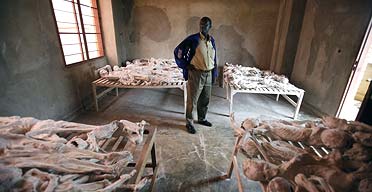
    The dead have been removed from their graves, preserved in lime, and placed in the rooms where they were killed, lain snugly together on wooden platforms.


    We knew we didn't have to go into the 28 different rooms, filled with a total of 800 corpses.

    But we did.

    Once the first room was opened, I realized what Stefanie (our Academic Director) meant when she said that the smell would be the thing we would always remember.
    Do you know what death smells like?
    I truly hope that you don't...
    ... and I'll never be able to explain it to you.
    I'll never forget the hour I spent breathing it in and trying to understand why.


    When I walked into the rooms, I walked right up to the corpses, an inch away from them.
    I could have touched them if I wanted to.

    There are no plaques to read, no informational pamphlets of facts and figures, no audioguide to spit information into your ear.  It is simply an emotional experience, a plain and simple truth you have to feel.


    There were children clutched in their mother's arms.
    There were heads with hair still attached, blowing ever so slightly in the breeze that wafted through the iron-barred windows.
    There were corpses still wearing their clothes, ill-fitting after decomposition.


    You could see the expressions on their faces: some horrified, some peaceful.

    You could see the contortions of their muscles, their bodies positioned as they had died: some in defensive stances, knees bent and hands outstretched to deflect the blows of the machete...
     and some, the children, curled up in positions not unlike how I sleep every night.


    The hardest thing for me to reconcile was how beautiful and peaceful this place seemed with the inhumanity and terror that occurred here.
    As I walked I could hear birds singing and children playing.
    When I stepped far enough away from the buildings, the only smell that hung in the air was the rain.
    I tried so hard to imagine what it must have been like for those who perished here, praying for salvation but knowing all they awaited was death.


    For a long time I've doubted the existence of God, but I've always had faith in humanity.  After this experience, however, all I felt was a growing feeling of fury towards mankind.  How could we have let this happen?  After the Holocaust and declaring "Never Again," the world stood by and watched as over a million innocent people were brutally slaughtered.  And yet we did nothing to stop it.  And now, today, after witnessing this and countless other genocides in our recent history, there are people being killed in genocides AS WE SPEAK.

    WHY?

    We joked that the next G20 summit should be held at Murambi.  Then we all paused a beat and realized it was probably the best solution we could ever come up with for the complete apathy of our society.

    You cannot visit Murambi and not leave a changed person.  It simply isn't possible.
    It isn't possible to leave without a new perspective, a shaken faith in your spiritual beliefs, a soul numb with the realization that we, as humans, are capable of such horrific crimes, and lungs full of air that only smells of loss and sadness.


    I don't know if I've done justice to this experience with these words... I doubt I have.  But that's only because it was such a visceral, emotional, and personal experience, and I honestly think its impossible to understand unless you've been there yourself.

    That said, I wish every single human being could share in this experience.

    I had the heartbreaking realization at Murambi that I don't have the power to make the world give a damn.  If compassion for injustice and for human life isn't already inside of you, it might never be.  Maybe that's why so many people couldn't understand why it is I needed to come to this place.
    So that begs the question: what is it that really matters in this world?
    Is it power, wealth, and influence?
    Or is it something more... compassion, tolerance, and forgiveness?

    After Murambi, we visited a women's cooperative in which women who have lost their families to the genocide live alongside women whose husbands are imprisoned as perpetrators.  When asked what message they wanted us to bring back to the west, one woman stood and left us with this:
    "Tell them to love, only love, and this will never happen again."

    And so this is the sentiment I leave with you: love.

    Monday, October 18, 2010

    Gisozi Genocide Memorial, Kigali

    Disclaimer: the upcoming few posts, mostly centered around the genocide memorials we're visiting here in Rwanda, might be graphic at times.  Please be careful reading them if you are in any way opposed to viewing detailed descriptions of the 1994 Rwanda genocide.

    That being said, if you are opposed... maybe you should read anyway.
    This is the reality of what happened here.
    Although its hard to read about... imagine living through it.
    And yet life goes on...


    What a fine way to kick off our stay in Kigali: a second-day slap in the face by genocide.

    Gisozi Memorial is the main genocide memorial in Kigali, and is home to a museum that tells the story of the Rwanda Genocide of 1994 and genocides around the world.

    Much more than simply a museum, it is also the site of mass graves of the victims of the genocide.  It is the final resting place of a quarter of a million Rwandans who lost their lives in and around Kigali in the 100 days of genocide beginning in April 1994.  (That's only a fraction of the estimated one million lives lost in the entire country.)

    Upon arriving at Gisozi, we were encouraged to wander the grounds and museum alone and to reflect on the impact of the memorial.  I began outside, looking at the mass graves, the incomplete wall of names of victims (which will never be complete... in many instances entire families were killed together, and there is therefore no way to account for every life lost... there is no one left to remember them), and the gardens surrounding the building.  It was difficult to connect with the reality of how many souls rest in this place, because the mass graves essentially consist of enourmous slabs of concrete raised a foot or so from the ground.

    It was impossible for me to imagine the grand scale of a quarter million people dead without cause.

    The gardens, aptly named things such as "Garden of Reconciliation," had a much stronger impact.  The symbolism incorporated into the gardens - concentric circles of rosebushes, flowing water between the separated gardens, statues of elephants to represent the desire to never forget - all tugged at my heartstrings.  I sat in the gardens for a while, trying to grasp the chaos that descended upon Kigali during those 100 days.

    The museum is divided into multiple sections: part is dedicated to the Rwandan genocide, part to genocides around the world, and part to the child victims of genocide.

    There is an abundance of information, statistics, and detailed accounts of the genocide, as well as smaller sections about international intervention (or lack thereof...), heroes of genocide, and reconciliation programs today.

    Not only is there detailed information and analysis, but also much more tangible artifacts:
    • A heavy chain and padlock, which was used to bind a man and woman together as they were buried alive.
    • A box full of machetes, clubs, axes, and shotguns, all weapons of mass murder.
    • There is a room full of bones and skulls, and a few had visible bullet holes or cracks - likely from a machete.
    • One was full of clothing... clothing people put on in the morning, not knowing it was to be the day they would die.
    • One room was full of photographs of victims.  Often, these were the only photographs families had of their lost loved ones, and they chose to give them to the memorial to be remembered by all who visit.


    The most difficult part of the memorial was the room for the child victims.  There were large photographs of the kids (most would be about my age now had they survived), again often the only ones their families had.  They were displayed above plaques that recounted information about them, often such things as their favorite games, favorite foods, their best friends, their personality traits...

    their last words:
    "Mom, where can I run to?"
    "UNAMIR will come for us."

    and how they were killed:
    • stabbed in the eyes.
    • repeatedly slammed against a wall.
    • shot in the head.
    • machete in his mother's arms.


    This is the reality of genocide.  Gisozi was difficult, but it was by far the most tame of the places we'll visit.  Tomorrow we travel to Murambi, which is the site of the massacre of over 40,000 Rwandans.  The bodies, preserved in lime, have been left as they were when they were killed.  We are told the smell of death permeates Murambi.

    And so this experience continues.

    All I can say is that despite the horror Rwanda has seen... life goes on.  I suppose that's all we can learn from anything.  Despite the worst... life goes on.

    Friday, October 15, 2010

    The Epic Update: Final Days in Uganda and Arrival in Rwanda!


    For the multitudes of family and friends back home that I haven't updated in a while, I've been in Kigali, Rwanda for three days now.

    Leaving Gulu was bittersweet.  I developed such a strong connection to my family, but it was time to move on to new things.  The only consolation is that I'll be back there in less than four weeks for my ISP.  I can't wait to see my family and friends again and get back to the comfortable, homey atmosphere of Gulu.  I'm literally counting down the days.

    Catchup on things we've done since leaving Gulu last week:

    JINJA:
    Jinja, on Lake Victoria, is home to the SOURCE OF THE NILE.

    I exist in Africa!  standing in front of the source of the River Nile.
    Yes, that's right.  I stood on a small island and watched deep blue water bubble up from an underground spring to flow over rapids and down waterfalls through Uganda, Sudan, and Egypt to the Mediterranean Sea.  (Some argue the source of the Nile is in Burundi... pish posh.)  Jinja was absolutely beautiful, and we also visited a series of waterfalls that will disappear at the end of this year when Uganda's newest dam is completed.


    MBARARA:
    Mbarara, in southern Uganda, is home to Nakivale Refugee Camp.  Although we didn't get to go to the camp due to a new rule that requires requesting permission from the Office of the Prime Minister, we talked with some of the Rwandan refugees who live in the camp.  Uganda hosts refugees from all over East Africa, but the ones we talked to were specifically from Rwanda.  They claim they fled Rwanda due to land conflicts and fear of violent retribution from victims of genocide, but it is also entirely possible that they were perpetrators in the 1994 genocide and fear prosecution by the Gacaca Courts.  I suppose we'll never really know.

    We were also reunited with the other half of our group, who have been in Rwanda this past month, in Mbarara.  I think we scared them a bit with our tales from Gulu... we all realized that it was definitely better to go to Gulu first, get the "worst" of it over, and then really appreciate the cushy life of Kigali.  And by cushy I mean reliable electricity and the resources of a metropolis.  That being said... I can't wait to go back to my lovely little Gulu.

    Doreen, one of the girls in my class and on the list of my top five favorite people in the entire world, is a native Ugandan and Rwandan.  Her family has a home in Mbarara, so Doreen, Rachel, and I skipped out on the hotel and stayed at her house for the two nights we were in Mbarara.  We were spoiled in her beautiful home, and I took my first hot shower in a real bathtub since I've arrived on this continent.  BEST. DAY. EVER.

    family photo time!


    And now, the biggie: ARRIVAL IN RWANDA!

    The drive through southern Uganda and northern Rwanda was nothing if not spectacular.

    Rwanda is the most densely populated country in sub-Saharan Africa, and therefore it is necessary for ALL land to be used in some way.  You'd be hard-pressed to find any land in Rwanda not being used for commercial, residential, or agricultural purposes.  The hills and mountains are terraced so that every inch can be farmed, and this makes for the most beautiful scenery I have ever seen.


    Once we got into the city, we settled in to our new office (which is stellar) and began our Kinyarwanda language lessons.  Much more difficult than you would expect, especially after a month of learning Acholi and Luganda.  But I need to learn this language if I want to communicate with my homestay mother, Faith, who doesn't speak a word of English apart from "How are you?"

    Kigali is so overwhelming, but much more manageable than Kampala.

    Best thing about this city so far?  THEY HAVE TRAFFIC LAWS AND A HEALTHY RESPECT FOR PEDESTRIANS.  I cannot say as much for Uganda.